Freshwater Animal Diversity Assessment Taxa Information Management System (FADAtims)
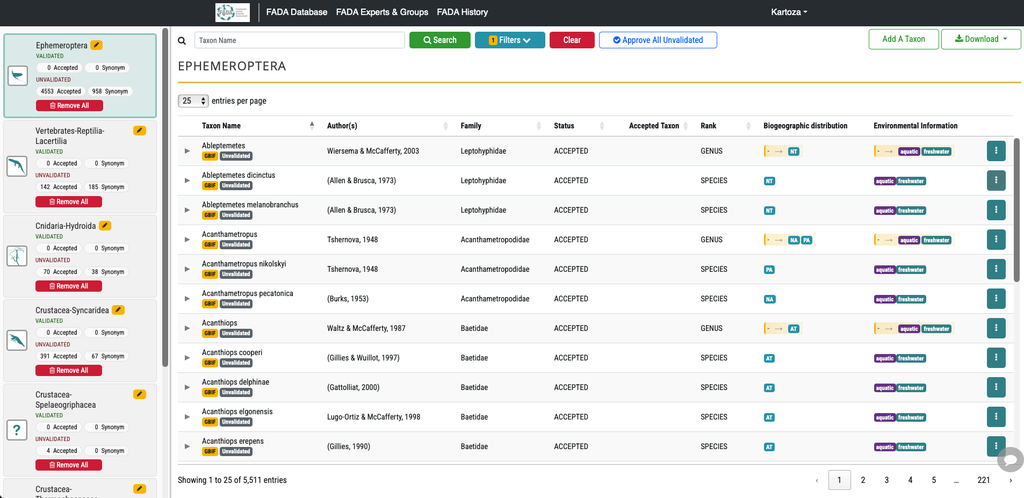
The infraFADA project is a critical initiative focused on modernising and expanding the global taxonomic backbone of the Freshwater Animal Diversity Assessment (FADA). The core deliverable is the development of the FADAtims (FADA taxa information management system), an online platform designed to allow FADA experts to efficiently curate, maintain, and publish their comprehensive taxa lists.
Overview
This work ensures the data is openly available to potential users and fully interoperable with international data infrastructures. Kartoza's role in the project is the development of the FADAtims software and platform
The primary aim of the project is to establish FADA taxa lists as a reliable taxonomic backbone for international research infrastructures. The key functional requirements for the FADAtims platform include:
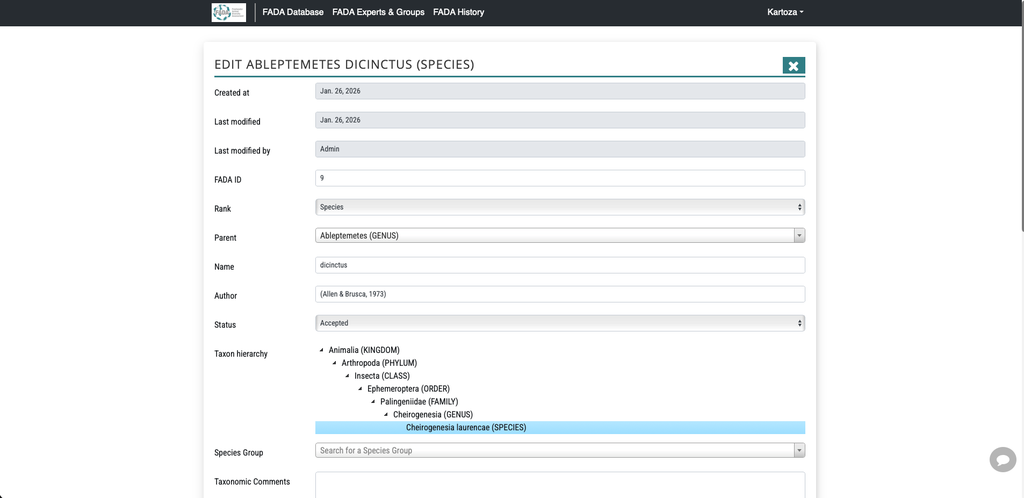
- Taxa Management: Implementing an online system for FADA experts to enter new taxa, insert taxonomic decisions, and manage synonyms, with all changes being time-stamped and logged.
- Hierarchical User Management: Developing a system to manage the global community of FADA experts with tiered administration levels (Level 1, 2, and 3) based on organism groups, regions, and countries.
- Expert Validation Workflow: Establishing functionality for experts and general users to propose new taxa with supporting evidence (including PDF uploads), which is then subject to expert review and validation.
- Interoperability: Developing links and APIs to ensure seamless data transfer and synchronisation between FADAtims and major global data infrastructures such as GBIF (Global Biodiversity Information Facility), Catalogue of Life (CoL), and other aquatic species registers like WoRMS (World Register of Marine Species).
- Data Access: Allowing both FADA experts and general users to query, browse, and download customized taxon lists (as CSV or PDF).
- Platform Integration: Ensuring BIMS instances (like FBIS - Freshwater Biodiversity Information System) can interoperate with FADAtims, allowing local platforms to select between their local taxonomy and the new, harmonized FADAtims taxonomy.
The History of FADA: A Global Legacy
The infraFADA project is the latest chapter in a long-running effort to document and manage freshwater animal diversity, which has consistently highlighted the field's knowledge gaps and conservation priorities.
- Initial Assessment (2002-2003): The project first emerged in the context of the international decade "Water for Life." The initial assessment identified approximately 100,000 known freshwater animal species.
- Comprehensive Review (2005-2008): A second, Belgian Science Policy (Belspo)-funded phase involved a consortium of close to 150 taxonomic experts. This initiative resulted in a more complete review, identifying more than 125,000 species and was published as a special issue of the journal Hydrobiologia.
- Database Compilation (2009-2013): During the EU-funded BioFresh project, the real FADA database, comprising taxa checklists for dozens of animal groups, was first compiled and became a core component of the Freshwater Information Platform (FIP).
- Data Improvement (2014-2016): The AquaRES project focused on improving data quality, updating import procedures, and ensuring synchronisation with other key registers like WoRMS.
The current infraFADA project builds on this two-decade legacy, transforming FADA from a database of checklists into an essential, highly-connected taxonomic backbone for global biodiversity research.
Project Timeline
Clients
.jpeg)


